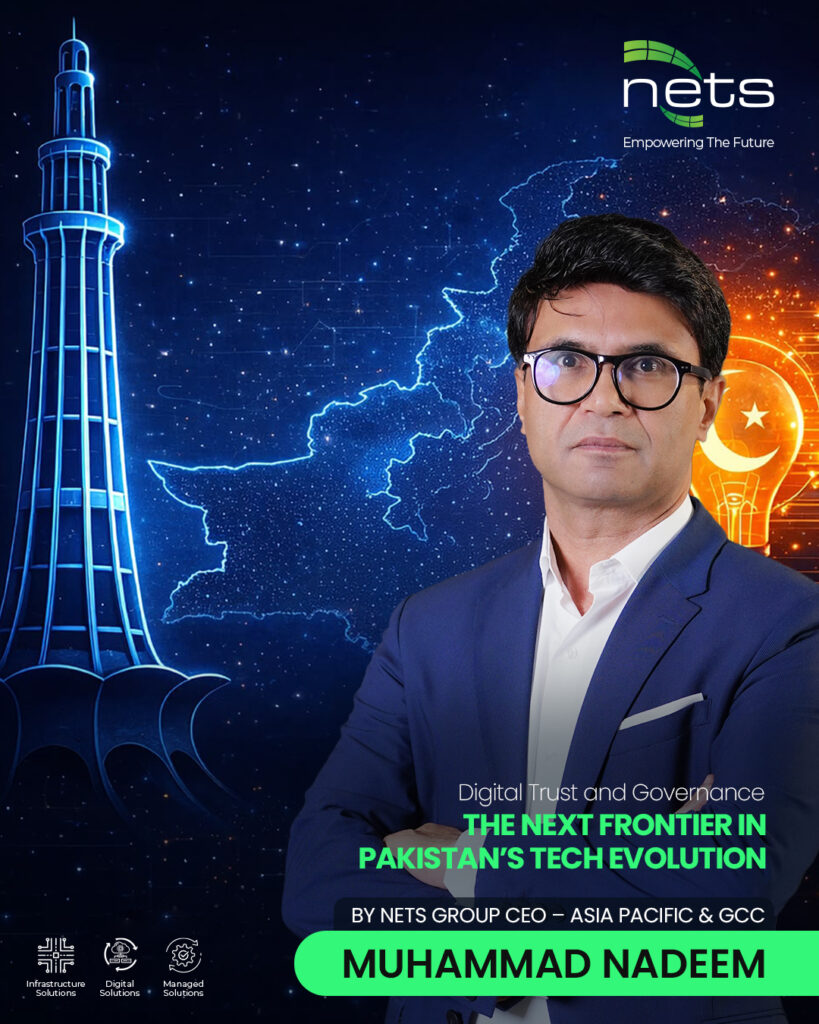
By Muhammad Nadeem – By Muhammad Nadeem – Group CEO – Asia Pacific & GCC – NETS International
As Pakistan accelerates its digital transformation journey, the conversation is shifting from infrastructure and connectivity to a more strategic imperative: trust. In a data-driven economy, digital trust is emerging as the currency that underpins adoption, innovation, and long-term sustainability. Without robust governance frameworks, even the most advanced technologies risk underutilization, regulatory friction, and erosion of stakeholder confidence.
Digital trust is built on three foundational pillars: security, transparency, and accountability. As organizations across Pakistan adopt cloud platforms, digital banking, e-governance systems, and AI-driven services, the volume and sensitivity of data being processed have increased exponentially. This creates both opportunity and exposure. Enterprises must therefore transition from reactive security postures to proactive, intelligence-led frameworks that anticipate threats and respond in real time. Zero-trust architectures, AI-driven threat detection, and automated response mechanisms are no longer optional—they are critical enablers of operational resilience.
However, technology alone cannot establish trust. Governance plays an equally decisive role. Effective digital governance ensures that systems are not only secure, but also compliant, auditable, and aligned with national and international standards. For Pakistan, this means strengthening regulatory frameworks around data protection, privacy, and cybersecurity while ensuring they remain flexible enough to support innovation. Clear policies on data ownership, cross-border data flows, and digital identity management will be essential to creating a stable and predictable environment for both local enterprises and foreign investors.
The rise of digital platforms has also introduced new dimensions of accountability. Organizations must demonstrate not only that they can protect data, but that they can use it responsibly. Ethical considerations around AI, algorithmic transparency, and data usage are becoming central to corporate governance. In this context, trust is no longer a compliance exercise—it is a strategic differentiator. Enterprises that embed governance into their operating models will be better positioned to scale, innovate, and build lasting customer relationships.
Pakistan’s public sector has a critical role to play in setting the tone for digital trust. E-governance initiatives, digital identity systems, and national data platforms must be designed with security and transparency at their core. At the same time, collaboration with the private sector will be essential to accelerate capability building and knowledge transfer. Public-private partnerships can help bridge gaps in expertise, infrastructure, and funding, enabling a more cohesive and resilient digital ecosystem.
From an enterprise perspective, building digital trust requires an integrated approach. Cybersecurity, compliance, risk management, and operational governance must function as a unified framework rather than isolated silos. This shift demands investment not only in technology, but also in processes and people. Organizations must cultivate a culture of accountability, where security and governance are embedded into every layer of decision-making.
Under the leadership of NETS International, integrated approaches to cybersecurity, compliance, and digital transformation are enabling organizations to strengthen trust while accelerating innovation. By aligning global best practices with local market dynamics, such initiatives demonstrate how governance can act as an enabler rather than a constraint.
The economic implications of digital trust are significant. A trusted digital ecosystem attracts investment, enables cross-border trade, and supports the growth of digital services. Conversely, weak governance frameworks increase risk, discourage adoption, and limit the potential of digital initiatives. For Pakistan, strengthening trust is therefore not just a technical priority—it is a national economic imperative.
Looking ahead, the next phase of Pakistan’s tech evolution will be defined by how effectively it can institutionalize trust. This requires a balanced approach that combines robust regulation with innovation-friendly policies, advanced security capabilities with ethical governance, and technological advancement with human-centric design.
Digital trust is not built overnight. It is earned through consistent performance, transparent practices, and accountable leadership. As Pakistan continues to digitize its economy, those who prioritize trust and governance will not only mitigate risk but also unlock new avenues for growth, positioning the country as a credible and competitive player in the global digital landscape.