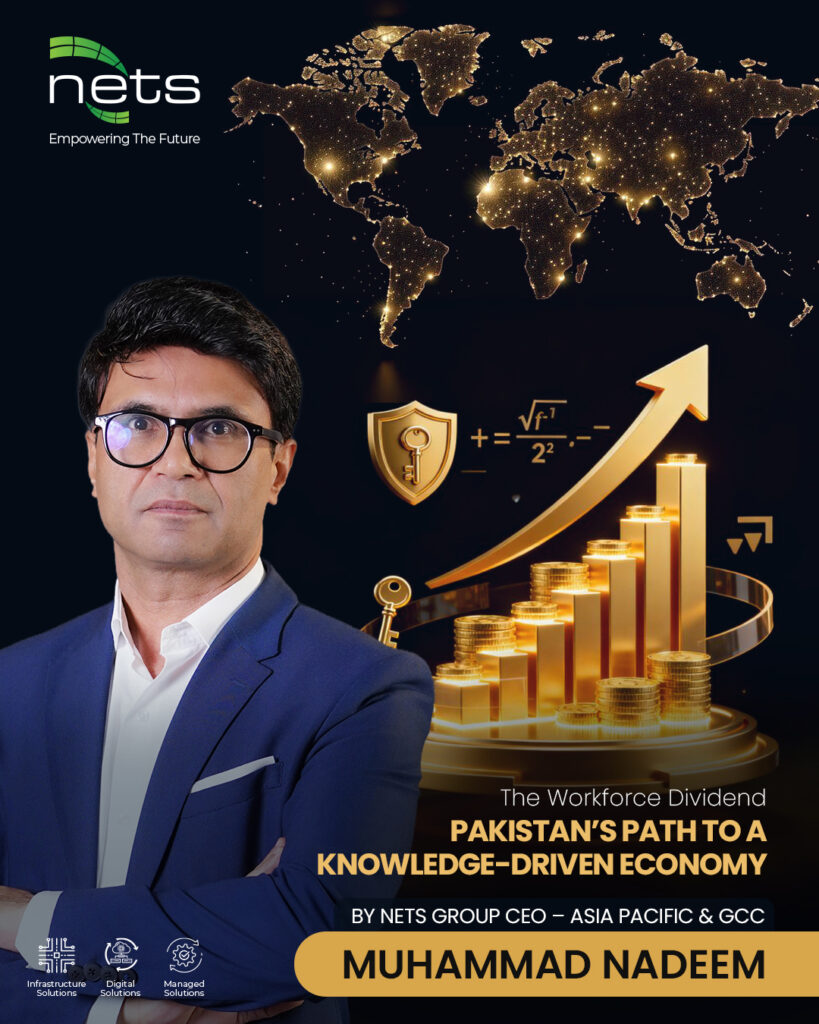
By Muhammad Nadeem – By Muhammad Nadeem – Group CEO – Asia Pacific & GCC – NETS International
Pakistan possesses one of the most compelling demographic advantages in the region—a young, rapidly growing workforce with the potential to become a powerful engine of economic transformation. However, demographic scale alone does not guarantee growth. The real opportunity lies in converting this population into a high-value, knowledge-driven workforce capable of competing in an increasingly digital and globalized economy.
The transition from a labor-intensive model to a knowledge-driven economy requires a fundamental shift in how talent is developed, deployed, and retained. Traditional skillsets, while still relevant, are no longer sufficient to meet the demands of modern industries. The future workforce must be equipped with capabilities in digital technologies, data analytics, cybersecurity, cloud computing, and artificial intelligence. At the same time, critical thinking, problem-solving, and adaptability are becoming equally important as technical expertise.
Pakistan has already demonstrated early signs of this transformation through the growth of its IT exports, freelance economy, and startup ecosystem. However, to sustain and scale this momentum, a more structured and strategic approach is required. Education systems must evolve from theory-driven models to practical, industry-aligned frameworks. Collaboration between academia and industry will be essential to ensure that graduates are not only qualified, but employable from day one.
At NETS International, we are proactively addressing the industry’s evolving skills gap through NETS Academy, our structured capability development initiative. By partnering with universities and institutions such as TEVTA, we are transforming labor-intensive resources into skilled telecom professionals through hands-on, industry-aligned training programs. Multiple training cohorts have already been delivered, focusing on fiber networks, operations, and HSE, enabling us to build sustainable, locally skilled workforce capacity and support long-term network performance across markets.
Equally important is the need to create pathways for continuous learning. In a rapidly evolving technological landscape, skills have a shorter lifecycle than ever before. Organizations must invest in upskilling and reskilling programs that enable employees to remain relevant and productive. This is particularly critical in sectors such as telecommunications, financial services, and digital infrastructure, where innovation cycles are accelerating.
From an industry perspective, the workforce dividend can only be realized if supported by the right ecosystem. This includes access to digital infrastructure, enabling policies, and a business environment that encourages innovation and entrepreneurship. Startups and SMEs play a vital role in this ecosystem, acting as catalysts for job creation and technological advancement. By providing access to funding, mentorship, and global markets, Pakistan can unlock significant value from its entrepreneurial talent base.
The role of leadership in this transformation cannot be overstated. Organizations must move beyond traditional management models and adopt a more agile, talent-centric approach. This involves fostering a culture of innovation, empowering employees to take ownership, and creating environments where diverse ideas can thrive. High-performance teams are not built solely on technical capability, but on trust, collaboration, and a shared vision for growth.
Under the leadership of NETS International, initiatives focused on talent development, knowledge transfer, and exposure to global best practices are contributing to the development of a more capable and future-ready workforce. By aligning local talent with international standards, such efforts demonstrate how organizations can play a pivotal role in shaping national capability.
The economic implications of a knowledge-driven workforce are substantial. Higher-skilled labor drives productivity, supports innovation, and enables the creation of higher-value industries. It also enhances Pakistan’s position in the global value chain, allowing the country to move beyond cost-based competitiveness toward capability-based differentiation.
At the same time, the social impact is equally significant. A skilled workforce leads to better employment opportunities, higher incomes, and improved quality of life. It also reduces dependency on traditional sectors and creates a more resilient and diversified economy.
The path forward requires a coordinated national effort. Government, industry, and educational institutions must align around a shared vision of human capital development. Policy frameworks should incentivize skill development, support digital inclusion, and encourage private sector participation in training and innovation initiatives.
Pakistan’s workforce dividend is not a guaranteed outcome—it is a strategic opportunity that must be actively realized. With the right investments, partnerships, and leadership, the country can transform its demographic advantage into a sustainable engine of growth, positioning itself as a competitive player in the global knowledge economy.